Translate

Friday, 1 April 2022

Myanmar’s crimes against the Rohingya warrant UN intervention

Source TheGuardian, 25 March

When individual states fail to protect their own populations, the international community must be prepared to act, writes Chris Hughes

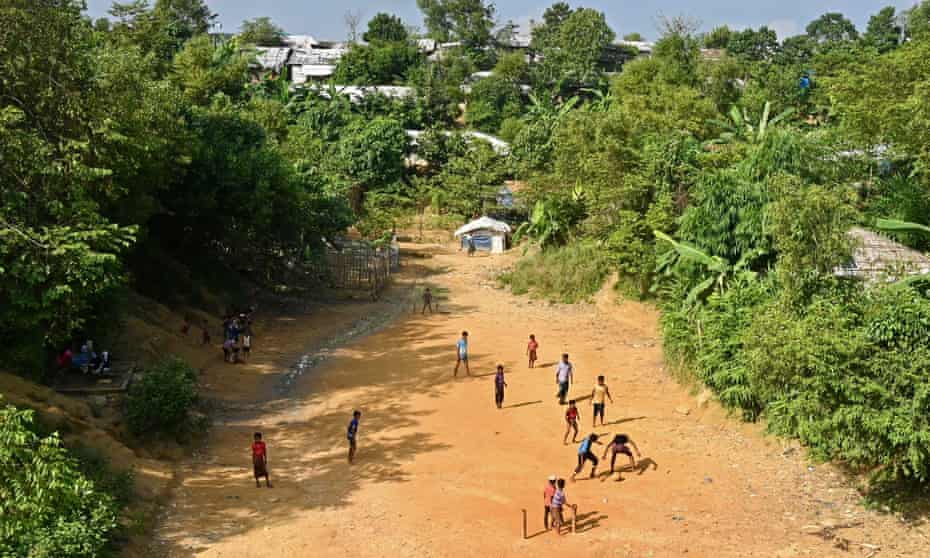
Children of Rohingya refugees play football at a camp in Ukhia.
Rohingya refugees at a camp in Ukhia, Bangladesh. The US has declared that Myanmar's mass killing of Rohingya Muslims amounts to genocide. Photograph: Munir Uz Zaman/AFP/Getty
Letters
Fri 25 Mar 2022 04.54 AEDT

Now that the US has finally accepted that Myanmar's ethnic cleansing and mass murder of Rohingya Muslims amounts to genocide (Rohingya refugees welcome US decision to call Myanmar atrocities a genocide, 22 March), the UN should enact its responsibility to prevent and respond to this most serious violation of international human rights and humanitarian law.

A 2005 UN world summit meeting agreed that all countries had a shared responsibility to do this. The summit agreed that the principle of state sovereignty carried with it the obligation of the state to protect its own citizens. However, if a state was unable or unwilling to do so, the international community was empowered to intervene.

The summit outcome document said "we are prepared to take collective action in a timely and decisive manner … should peaceful means be inadequate and national authorities are manifestly failing to protect their populations from genocide, war crimes, ethnic cleansing and crimes against humanity". No doubt Russia and China would veto any such move, but it should be proposed.
Chris Hughes
Leicester

Myanmar junta leaders may face war crimes probe in Australia

Source TheAge, 22 March

Singapore: Leaders of Myanmar's military junta could be investigated in Australia for alleged war crimes committed by security forces since they seized power in a coup last year.

Cases against several military figures, from field commanders to junta leader Senior General Min Aung Hlaing, are being prepared by Myanmar's National Unity Government (NUG), a shadow administration of officials elected before the coup. They would be pursued in Australia under universal jurisdiction.

In this photo provided by the Karenni Nationalities Defense Force, smokes and flames billow from vehicles in Hpruso township, Kayah state, in which people were shot and burnt on December 24.

In this photo provided by the Karenni Nationalities Defense Force, smokes and flames billow from vehicles in Hpruso township, Kayah state, in which people were shot and burnt on December 24.CREDIT:AP

The move allows for individuals suspected of committing crimes against humanity, genocide, torture and other war atrocities to be tried under Australian law even if the alleged acts did not take place on Australian soil.

Dr Tun-Aung Shwe, the NUG representative in Australia, told The Sydney Morning Herald and The Age he had engaged the pro bono division of law firm Gilbert + Tobin to bring the cases before Attorney-General Michaela Cash or her successor if Labor wins government at the upcoming federal election.

Such prosecutions need the approval of the top law officer in the country to proceed but Shwe argues the evidence of atrocities is too compelling to ignore.

He said the cases against officials in the Tatmadaw, as the military is known, would revolve around mass killings in Kayah state in eastern Myanmar and the Sagaing region, in the north-west, as well as clearance operations in western Chin state in which civilians were targeted and villages burnt to the ground.

Junta chief Senior General Min Aung Hlaing.

Junta chief Senior General Min Aung Hlaing.CREDIT:AP

Among them is last year's horrific Christmas Eve massacre in Kayah's Hpruso township in which at least 35 people were shot and incinerated in their cars. The victims included two staff members from the humanitarian organisation Save the Children.

According to Shwe, the cases are being made against field commanders in the regions where the atrocities took place as well as those deemed to have overall responsibility for the military's conduct, principally Min Aung Hlaing.

Danny Gilbert, the managing partner at Gilbert + Tobin, said: "We have been asked by some prominent Burmese Australians to investigate the possibility of bringing war crime charges against members of the Myanmar military junta.

"A national government needs to commence such a claim so our role would be preparing a brief to try to persuade the federal AG to act."

Shadow attorney-general Mark Dreyfus said, if elected, Labor would "carefully consider any proposals to help bring to justice military figures in Myanmar guilty of war crimes".

Cash's office was contacted for comment.

There are international precedents under the premise of universal justice including European nations investigating war crimes in Syria, Iraq and now by Russian forces in Ukraine. A court in Argentina also last year approved an investigation into atrocities perpetrated by the Myanmar military against the Rohingya ethnic minority in 2017 that were this week determined by US President Joe Biden's administration to have amounted to genocide.

In Australia, the investigating agency would be the Australian Federal Police.

Aung San Suu Kyi with Min Aung Hlaing, right, before the coup. She has been detained since February 2021 on 17 charges brought against her by the junta that could see her sentenced to more than 100 years in prison.

Aung San Suu Kyi with Min Aung Hlaing, right, before the coup. She has been detained since February 2021 on 17 charges brought against her by the junta that could see her sentenced to more than 100 years in prison.CREDIT:AP

Rawan Arraf, a lawyer and executive director of the Australian Centre for International Justice, has urged Australia to take on universal jurisdiction cases and for the AFP to establish a permanent war crimes investigation unit, not least because the veto power of states on the United Nations Security Council dilutes the reach of the International Criminal Court.

"Australia should step in and ensure that perpetrators do not enjoy impunity," she said.

There have been several applications in Australia in the past decade, most notably in 2018 when a group of Australian lawyers tried to have Myanmar civilian leader Aung San Suu Kyi prosecuted over the ethnic cleansing of the Rohingya, and in 2011 when a case was brought against Sri Lanka's then president, now Prime Minister Mahinda Rajapaksa for its military's killing of as many as 40,000 Tamil civilians during the civil war. Both were dismissed because they had immunity under international law as heads of state or heads of government.

The newly formed Australian Office of the Special Investigator is delving into allegations of war crimes by Australian special forces in Afghanistan but Arraf believes "the will of the police to undertake investigation of international crimes, particularly where there is no real Australian link, has not been there".

Labor and non-government organisations have called on Australia to follow the US, United Kingdom, European Union and others by imposing targeted sanctions on Myanmar's military junta, which calls itself the State Administration Council. But Foreign Minister Marise Payne has indicated sanctioning the regime is not in Australia's national interest.

The government has been unsuccessful in securing the release of Australian economist Sean Turnell, an advisor to Suu Kyi who has been detained in Yangon and Naypyidaw since February 2021. He is facing charges brought by the junta of violating state secrets.

The UN last week released a report cataloguing the Myanmar military's deliberate targeting of citizens, including with air strikes on heavily populated areas, declaring "the appalling breadth and scale of violations" could amount to war crimes and crimes against humanity.

Attempts to contact Myanmar SAC spokesman Zaw Min Tun were unsuccessful.

Friday, 11 February 2022

Myanmar: while the world sits on its hands, people fight military junta with violence and silence

Source TheConversation, 1 Feb

A year after a military coup, Myanmar remains mired in conflict. The country's military, the Tatmadaw, has failed to convince most of Myanmar's 55 million people of the legitimacy of its rule. Anti-coup resistance continues to be widespread nationwide.

The anniversary will be marked within Myanmar by a "silent strike", with participants acknowledging those jailed or killed by the junta during the last year by avoiding public space, leaving Myanmar's streets empty. The junta has threatened participants with decades-long jail sentences and property confiscations. But if previous calls for anti-coup resistance are an indication, tens of millions of people will stay home and Myanmar's streets will be spookily empty.

Silent strikers have a lot of people to acknowledge. The junta has jailed 11,838 according to Myanmar's Assistance Association for Political Prisoners. This included State Counsellor Aung San Suu Kyi, President Win Myint and as many of Myanmar's civilian politicians as the military could round up and have killed – 1,503 – often with appalling cruelty.

In the immediate wake of the coup, hundreds of mostly young, peaceful protesters were killed by army snipers. In ethnic minority areas, soldiers replicated the kinds of scorched earth tactics used when the Tatmadaw genocidally deported the Rohingya in 2017.

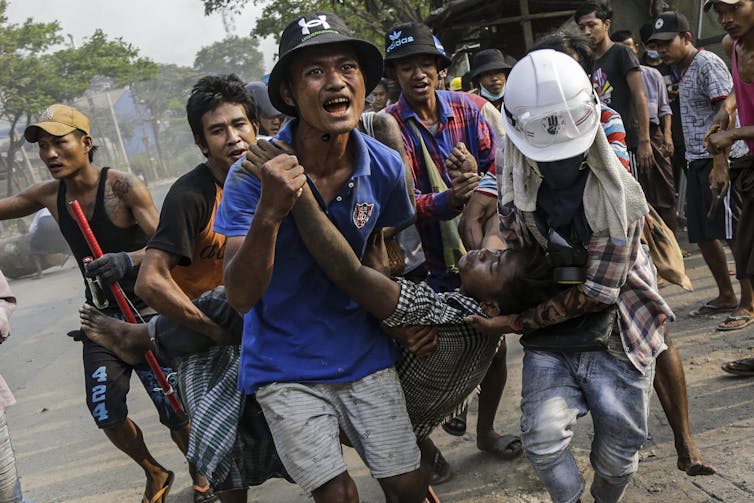
Group of Burmese men carry injured man while shouting.
A crackdown after the coup killed hundreds of protestors. EPA

Recent indiscriminate atrocities include the driving of a truck into a crowd of peaceful protesters, the burning alive of 11 people including four children in retaliation for an attack by anti-junta militia, and the massacre of 31 people fleeing violent clashes.

Rather than quelling popular opposition to military rule, the junta's brutality and extreme violence has instead convinced many people of the necessity of removing the military from power for good. Resistance has encompassed a broad range of activities including peaceful protests that drew global attention, and civil disobedience and strikes that have paralysed the bureaucracy and transport sectors. Increasingly this has included violent opposition to the junta.

Resistance is strongly encouraged by the National Unity Government (NUG), a shadow government in exile that draws heavily from politicians elected at the 2020 general election. In September, NUG leaders announced a "defensive war" against the junta, encouraging the creation of People's Defence Force militias to target the Tatmadaw and its assets.

These militias have increasingly linked with the armed wings of Myanmar's ethnic minority groups, of which there are dozens, many of whom have themselves been in conflict with the Tatmadaw for decades. A nationwide united front of militias and ethnic armed groups has the potential to significantly stretch Tatmadaw capabilities.

Economic shambles

Creating a further challenge for the junta is the shambolic state of the economy. The World Bank estimated an 18% contraction during 2021 and predicted a paltry 1% growth in 2022, describing the economy as "critically weak". The national currency, the kyat, has fallen to historic lows, losing 60% of its value in September alone.

The World Food Program estimated a 29% rise among a basket of basic foods, and a 71% hike in fuel prices during 2021, contributing to widespread food insecurity and pushing millions towards poverty.

The perilous state of the economy has revived memories of the shockingly poor economic management during previous periods of military rule which saw Myanmar (then Burma), in 1987, designated a "Least Developed Country" by the UN.

Mixed diplomatic messages

Internationally, the news for the junta is mixed. Military-ruled Myanmar is isolated diplomatically, the military government has been barred from participation in meetings of the Association of Southeast Asian Nations (Asean), and Myanmar's delegate to the UN General Assembly speaks on behalf of the NUG, rather than the junta. But the generals have not had to face foreign intervention, an arms embargo, or even a UN Security Council referral to the International Criminal Court (ICC).

Western political leaders have been strong on anti-coup rhetoric and have imposed a range of economic sanctions, but there has been a studied reluctance to go beyond that. Most have been comfortable with Asean taking responsibility for addressing the situation in Myanmar. But the consensus-based regional bloc has proven unable to take decisive action, and its "five-point consensus" has been variously frustrated and ignored by the junta.

At the security council, neither the US, UK, nor France, all permanent members who have condemned the coup, has been prepared to force a vote on imposing an arms embargo or referring Myanmar's generals to the ICC. This might at least encourage Myanmar's defenders at the UN and its major arms suppliers – China and Russia - to push the junta to moderate its actions.

This situation is reminiscent of the west's response to the 2017 Rohingya crisis, when soaring rhetoric was not matched with actions to prevent criminality or achieve accountability. This arguably contributed to the Tatmadaw's sense of impunity which underpinned its decision to launch the current coup, convinced that it might face condemnatory rhetoric but little else from the UN or western governments.

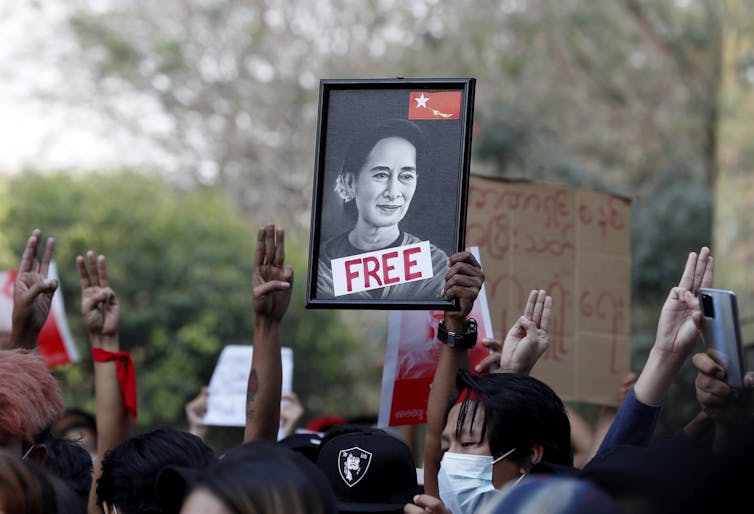
Group of protestors making three-fingered salutes and holiding picture of Aung San Su Kyi with the word 'free'
Civilian leader Aung San Su Kyi has been sentenced to six years in prison. EPA

Edge of collapse

Military boss Min Aung Hlaing now presides over a crisis-riven country at the edge of complete political and economic collapse. While the junta has unquestionably failed to win hearts and minds and appears to have wildly underestimated the likely domestic opposition to renewed military rule, there are few indications the junta is considering any compromise that might see the Tatmadaw return to its barracks.

Meanwhile, held incommunicado for a year, Aung San Suu Kyi, the winner of the 2020 general election, has been recently sentenced to six years in jail via an absurd, military-run court process.

All this suggests Myanmar faces a worrying future: a military determined to rule and prepared to use appalling violence to achieve power, and a population equally determined to remove the military from power.

A protracted conflict will have devastating consequences for Myanmar's people. By imposing an arms embargo on the Tatmadaw, the security council could help to defeat the junta more quickly. In the silent strike, millions of people will bravely risk decades in jail to protest military rule that is as illegitimate as it is cruel. They will be hoping the security council can show some bravery too.

Friday, 28 January 2022

Australia: Sanction Myanmar’s Coup Leaders

Source HRW, 27 Jan

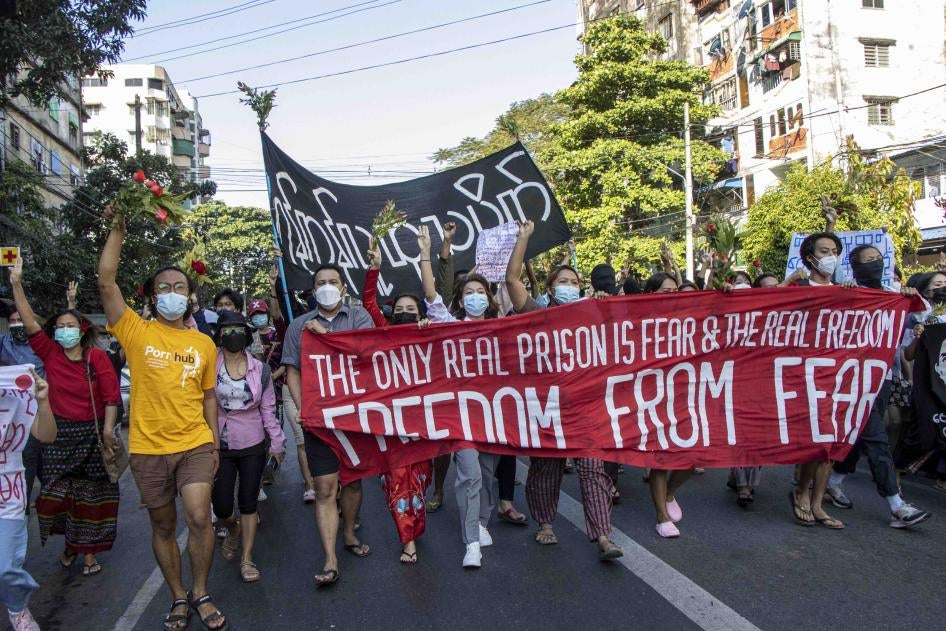
Demonstrators in Yangon protest the military coup in Myanmar, December 4, 2021. © 2021 Santosh Krl / SOPA Images/Sipa USA via AP Images

(Sydney) – The Australian government, one year after Myanmar's February 1, 2021 military coup, should impose targeted sanctions on Myanmar's abusive military leaders and their business interests, six nongovernmental organizations said in a letter to Foreign Minister Marise Payne released today.

In December the Australian government passed amendments to enable targeted sanctions against serious human rights abusers, but the sanctions have not been used. In the past year governments such as the United States, the United Kingdom, Canada, and the European Union have imposed various targeted sanctions against Myanmar individuals and entities.

The letter was signed by the Australian Centre for International Justice, Australian Council for International Development, Australian Council of Trade Unions (ACTU), Human Rights Watch, Publish What You Pay, and the Refugee Council of Australia.

Since the Myanmar military overthrew the elected civilian government last year, the Australian government has not imposed any additional sanctions on military leaders or their business interests. Since then, the military junta has carried out a nationwide crackdown on anti-junta protesters and the political opposition that amounts to crimes against humanity.

State security forces have killed more than 1,500 people, most recently the horrific summary execution of at least 39 people, including 4 children and 2 humanitarian workers, in Karenni State, yet no one has been held accountable for these crimes. Australia should demonstrate its strong public opposition to these atrocities by announcing targeted sanctions on February 1, 2022, the organizations said.

On January 27, the Australian company Woodside, a natural gas producer, announced it was exiting from Myanmar, underscoring the need for coordinated and targeted sanctions from Australia, the US, EU, and other concerned governments on Myanmar's natural gas revenues.

The letter to Australia's foreign minister lists the individuals and entities who should face sanctions. Acting on that list should serve as a starting point for the Australian government to harmonize its position on Myanmar with like-minded governments.

Quotes from signatories to the letter:

"Australia should mark the one-year anniversary of Myanmar's coup by joining join its allies in imposing targeted sanctions against Myanmar's abusive generals and military-owned businesses. The Australian government should heed the calls of people in both Australia and Myanmar to help deprive the military of its revenue sources and to maximize pressure on the junta to end its campaign of terror."

Elaine Pearson, Australia director at Human Rights Watch

"The Australian government needs to act by introducing targeted sanctions, and not just wring its hands. The Myanmar generals stand accused of committing genocide and crimes against humanity against the Rohingya people and snuffing out democratic government, and attacking their own people for voicing democratic aspirations. When will the Australian government stand up for freedom and democracy?"

Marc Purcell, chief executive officer of the Australian Council for International Development

"A year on from the military coup in Myanmar, the Morrison government has failed to introduce further sanctions against Myanmar's military leaders and business interests – putting Australia behind likeminded countries like the US, UK and EU. Workers in Myanmar are risking their lives to protest the military takeover while the Morrison government sits idly by, when they should be taking action to support democracy."

Michele O'Neil, president of the Australian Council of Trade Unions (ACTU)

"The mining, oil and gas sectors are like an ATM for Myanmar's murderous military. The Australian government should introduce sanctions that will outlaw Australian mining, oil and gas companies lining the pockets of the generals with tax and royalty payments."

Clancy Moore, Australian director of Publish What You Pay

Rebel yell: Arakan Army leader speaks to Asia Times

Source Asiatimes, 18 Jan

Tun Myat Naing, commander-in-chief of the Arakan Army (AA), attends a meeting of leaders of Myanmar's ethnic armed groups at the United Wa State Army (UWSA) headquarters in Pansang in Myanmar's northern Shan State, May 6, 2015. Rebel leaders in Myanmar on Wednesday urged the government to amend the military-drafted constitution to give more autonomy to ethnic minorities, a step they said would make it easier to sign a national ceasefire agreement.    REUTERS/Stringer - RTX1BTVZTwan Mrat Naing, commander-in-chief of the Arakan Army, attends a meeting of leaders of Myanmar's ethnic armed groups at the United Wa State Army headquarters in Myanmar's northern Shan state, May 6, 2015. Photo: Twitter

CHIANG MAI – At just 43, Major General Twan Mrat Naing may be the youngest and most successful rebel commanders in Myanmar. The force he leads, the Arakan Army (AA), has grown from a handful of recruits when it was first established in April 2009 into one of the war-torn nation's most powerful and potent ethnic armies.

AA first waged war against the Myanmar military in 2012 in northern Kachin state arm-in-arm with the Kachin Independence Army (KIA). It later fought alongside the Myanmar National Democratic Alliance Army (MNDAA) in northeastern Shan state before launching an insurgency in its home state of Rakhine, also known as Arakan, where thousands have flocked to join its ranks.

Thanks to an unofficial ceasefire reached in late 2020, Rakhine state has not seen the kind of turmoil and violence that has engulfed the rest of the country since the military's democracy-suspending coup last February 1. In that relative vacuum, AA and its United League of Arakan (ULA) political wing have gradually built up a parallel administration and now effectively run much of the state, especially its northern regions.

But AA's rebel threat is alive and well, not least through its membership in three key anti-military alliances – the Brotherhood Alliance, the Northern Alliance and the Federal Political Negotiation and Consultative Committee (FPNCC) – that combined account for most of the nation's ethnic fighting forces. If AA were to resume its hostilities full force, some believe it could critically overstretch the Tatmadaw.  

In his first lengthy interview with international media, Twan Mrat Naing recently spoke over digital media with Asia Times' senior correspondent Bertil Lintner about the future of AA and prospects for Myanmar's spiraling civil war.

Asia Times: The situation in Arakan (Rakhine) has been relatively calm since you entered into an informal ceasefire agreement with the Myanmar military shortly after the November 2020 election. But, given the fact that the rest of Myanmar is in turmoil, for how much longer do you expect the peace to last?

Twan Mrat Naing: The informal ceasefire is not that stable.  We have been at daggers drawn. It's uncertain how long the ceasefire will last, but we wish to have a meaningful ceasefire for mutual benefit and interests.

The SAC [State Administration Council] is fighting on other fronts but with an ad hoc strategy. We know they are furious because we have established our own administration with judicial, taxation, public security branches and other governmental institutions.

Asia Times: What is your relationship with other ethnic armed organizations in Myanmar, not only your allies but also the Karen National Union (KNU), the Karenni National Progressive Party (KNPP) and its Karenni Army, and the Restoration Council of Shan State (RCSS), which are not members of any of the fronts to which you belong?

Twan Mrat Naing: The Arakan Army is actively engaging in the operations of the Brotherhood Alliance and the Northern Alliance, and we are still a member of the FPNCC. We also maintain good relationships with the KNU, the KNPP as well as most other ethnic armed organizations.

Myanmar's insurgent Arakan Army has deployed hit-and-run tactics the military has found difficult to counter and combat. Photo: Twitter

Asia Times: What is your overall assessment of the SAC's performance since it seized power on February 1 last year? Are talks possible or is armed struggle the only way forward?

Twan Mrat Naing: The SAC's health system is crumbling, economically the country is going bankrupt and the country is paralyzed politically. SAC is paranoid and has become more of a diplomatic pariah than ever before. And its military is overstretched on many fronts. The junta has found itself in the middle of a storm, and they do not have much leeway for any mistake.

Once their chain of command and cohesion is disrupted with inner cleavages and mutinies, they could be blown out like a supernova. But we can't underestimate their military strength and resilience – they will do anything to remain in power and they have manifested that with indiscriminate barbarity.

It seems to me that peace talks are very unlikely under current circumstances. With such animosity prevailing, peace talks would amount to mere political rhetoric, not real negotiations.

Asia Times: How do you view the National League for Democracy's role (NLD) in national politics and the Arakan National Party (ANP), the main overground political party in Rakhine state, in regional politics?

Twan Mrat Naing: NLD is not in very good shape either, although it won the majority of votes in a staggering victory in the previous [2020] election. But with its aging and ossified leadership, its future does not look promising and is not up to the expectations of the people. The NLD needs a new leadership, or, for the good of the people of Myanmar, another new capable political force should take over in the political vacuum that exists today.

In regard to the ANP, it would hinge on whether or not there will be an election in 2023, as promised by the SAC. [Myanmar's] political future is dire and unpredictable. Another likely scenario for ANP is that it could merge with the ULA along with other parties and individuals if there are no more elections in the years to come.

Asia Times: Is your final goal independence for Arakan (Rakhine) or autonomy within a federal union? What kind of future state structure do you envisage for Myanmar?

Twan Mrat Naing: The right to self-determination and sovereignty is at the heart of our national movements. We will see whether a Federal Union of Myanmar will have the political space for the kind of confederation that our Arakanese people aspire for.

We would prefer to remain with our [ethnic] brothers and sisters, but if our rightful political status which we desire is not accommodated within this union, it would behoove us to be a member of the international community on our own.

Asia Times: How strong is your army and how much of Arakan (Rakhine) does it control?

Twan Mrat Naing: We have trained over 30,000 soldiers in 13 years (since founding in 2009), and there are still more combatants undergoing training in command and control, and technical skills. Around 70% of our troops are battle-hardened and have combat experience. 5,000-6,000 thousand troops are deployed in our allies' areas, the rest are in Arakan (Rakhine).

We control around 60% of the areas in the north of Arakan (Rakhine) but less in the south. In some areas, it is difficult to draw distinct lines of control between us and the Myanmar army. They still control urban areas and have to keep those for strategic reasons, but we still project our authority as required in those areas and there are still a lot of contested areas as well.

An Arakan Army rebel soldier at an undisclosed location. Photo: YoutubeAn Arakan Army rebel soldier at an undisclosed location. Photo: Youtube

Asia Times: What is your relationship with the People's Defense Forces and associated resistance armies in nearby Chin state?

Twan Mrat Naing: So far, no significant cooperation. 

Asia Times: You said in an interview published by Prothom Alo (Bangladesh) on January 2 that you recognize the human rights and citizenship rights of the Rohingyas. Does that mean you are advocating the return of Rohingya refugees now in Bangladesh and their right to citizenship?

Twan Mrat Naing: We recognize the human rights and citizenship rights of all residents of Arakan (Rakhine), but a massive repatriation of refugees in the current situation could unleash a new wave of unrest. Any repatriation would have to be voluntary and be done by legal means under international supervision.

A major issue for most Arakanese would also be the name with which the refugees would want to be identified. "Rohingya" is not a term that most Arakanese accept. They find it offensive as they feel that it deprives them of their history. They are the original inhabitants of the land.

The Muslim population has come in different waves, and then chiefly when the country was under British rule. If they have lived in Arakan (Rakhine) for generations, they can become citizens. But it's also a question of identity.

Asia Times: What are the chances of Muslims, Buddhists, Hindus and Christians being able to live together peacefully in Arakan (Rakhine)?

Twan Mrat Naing: It is achievable when we don't have outsiders manipulating us and using one group against another. Evidently, our Arakan (Rakhine) state never had the current level of social stability and racial harmony during 1941/2 to 2019. Now, we have more social stability, racial tension has started to decline and more positive social activities can be found. These are observable shifts and more changes should be started from within.

Asia Times: What is your view of Rohingya organizations such as the Rohingya Solidarity Organization (RSO) and the Arakan Rohingya Salvation Army (ARSA)?

Twan Mrat Naing: We do not have any ties with either of them. The RSO appears to be politically more mature than ARSA. But ARSA has more networks and is more active. You can see what ARSA has been doing against their own community leaders at the villages inside Arakan (Rakhine) and at refugee camps in Bangladesh. Some educated Muslims in the diaspora are irresponsibly manipulating ARSA and exploiting the troubled political environment.

Asia Times: Your only foreign neighbor is Bangladesh. How would you describe your relationship with authorities and people across the border, for instance the Marma community? And, a bit further afield, India?

Twan Mrat Naing: The Marma, and the Magh (the Mog of Tripura) are of the same blood as us, as are other ethnic inhabitants across the tri-border region. They have a profound understanding of our movement and sympathy for us.

In regard to Bangladesh's authorities, it's not that bad, but not yet so good either. We haven't noticed that the Bangladesh government has a clear policy or strategy for a formal or informal relationship with us yet.

It should be improved though; they should take a step forward and do so proactively. A better relationship will be mutually beneficial for both of us, and, more importantly, in coping with the refugees, aid delivery, the pandemic and security issues. In order to better serve the interests of the people on both sides, the relationship could also be extended to include health care, education, trade and commerce and other sectors.

Rohingya men look at smoke billowing above what is believed to be a burning village in Myanmar's Rakhine state, as members of the Muslim minority group take shelter in a no-man's land between Bangladesh and Myanmar, in Ukhia on September 4, 2017. Photo: AFP/ K M AsadRohingya men look at smoke billowing above what is believed to be a burning village in Myanmar's Rakhine state, as members of the Muslim minority group take shelter in a no-man's land between Bangladesh and Myanmar, in Ukhia on September 4, 2017. Photo: AFP / K M Asad

Asia Times: Can other countries such as China and Japan play a role in the efforts to reach a peaceful solution to the conflict in Arakan (Rakhine) and the rest of Myanmar? What about the strategic competition between China and the United States?

Twan Mrat Naing: In theory, they can play a vital role but reality is more complex. Changes have to come from within, and that would sound more probable and realistic to me. But the odds are still unclear. The US-China competition has not affected us and is not our concern.

Asia Times: And, lastly, a personal question: why and when did you decide to take up arms against the Myanmar military and the rule of the central government?

Twan Mrat Naing: Myanmar does not have a healthy political space to settle political inequalities and entitlements. I won't be crying for the moon. My rationale is that we are not requesting or asking for what we want from our enemy who has deprived us by force.

We shall create our own destiny with our own hands, no matter what they think. We must build on our own and earn what we deserve. My mission is to restore our sovereignty and reclaim a rightful political status for Arakan (Rakhine).

Follow Bertil Lintner on Twitter at @gardlunden